LIFE DEEP DIVE 01
How do you make a star disappear?
To study the faint light of an Earth-like exoplanet, LIFE must first suppress the glare of its star. Inside the laboratory for astronomical instrumentation at ETH Zürich, our NICE team is testing the precision, stability and sensitivity this will require.
Technology ・ 12 Min Read ・ September 2026
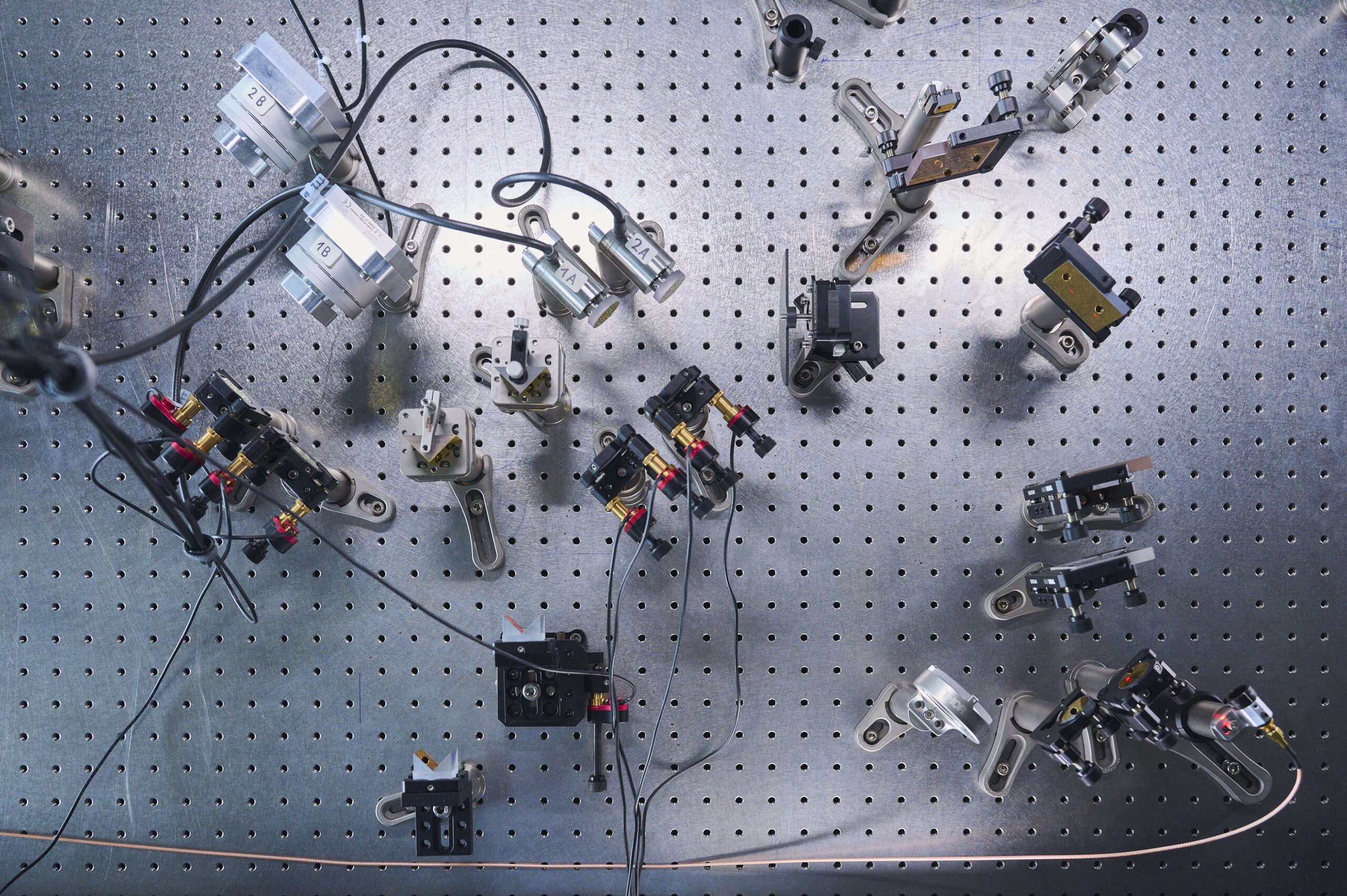
Across an optical table crowded with mirrors, fibres, actuators and detectors, our team is trying to measure almost nothing.
Not because nothing is happening. Quite the opposite.
The Challenge
The problem with stars
An Earth-like planet orbiting a Sun-like star is extraordinarily difficult to observe directly. The planet appears close to the star and is vastly fainter. Its light is easily lost in the stellar glare.
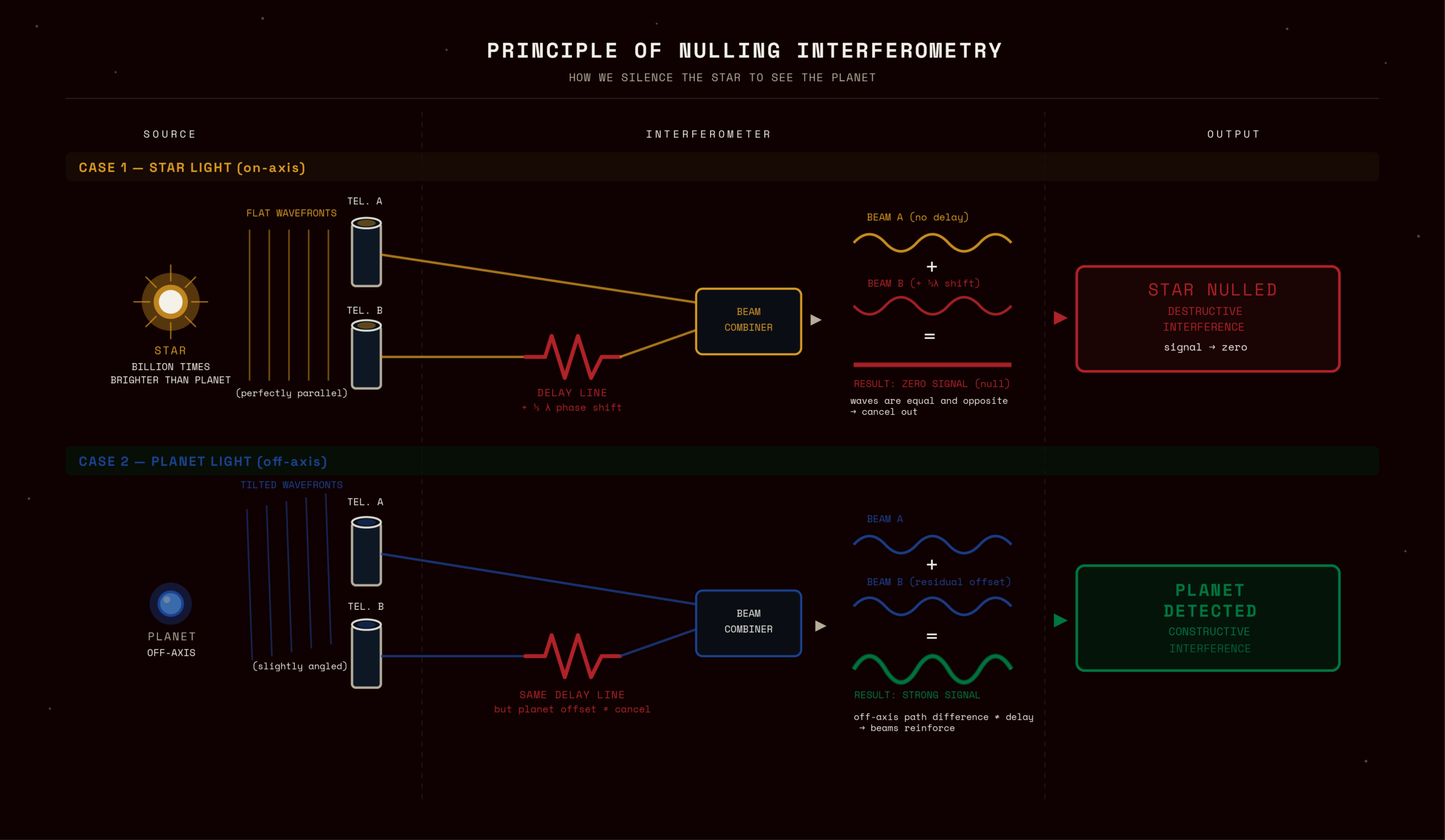
LIFE is being designed to overcome this problem by combining light collected by multiple telescopes flying in formation in space. The light from the central star would be made to interfere destructively — suppressed at the beam combiner — while light arriving from an off-axis planet would be transmitted and could reach the detector.
The concept is powerful. But before an instrument based on it can operate in space, its critical technologies need to be demonstrated here on Earth.
THE SOLUTION
Meet NICE: Nulling Interferometry Cryogenic Experiment (NICE)
Developed within the LIFE Space Mission, NICE is a laboratory testbed for the heart of the LIFE’s future science instrument. Its long-term objective is to demonstrate deep and stable starlight suppression across the broad mid-infrared wavelength range LIFE requires, using realistic light levels and cryogenic conditions.
“By physically building the instrument in the lab, we can find the effects that are easy to overlook in a simulation — and learn how to deal with them before they become mission problems.”
Jonah Hansen, NICE Lab LEAD
The People behind NICE
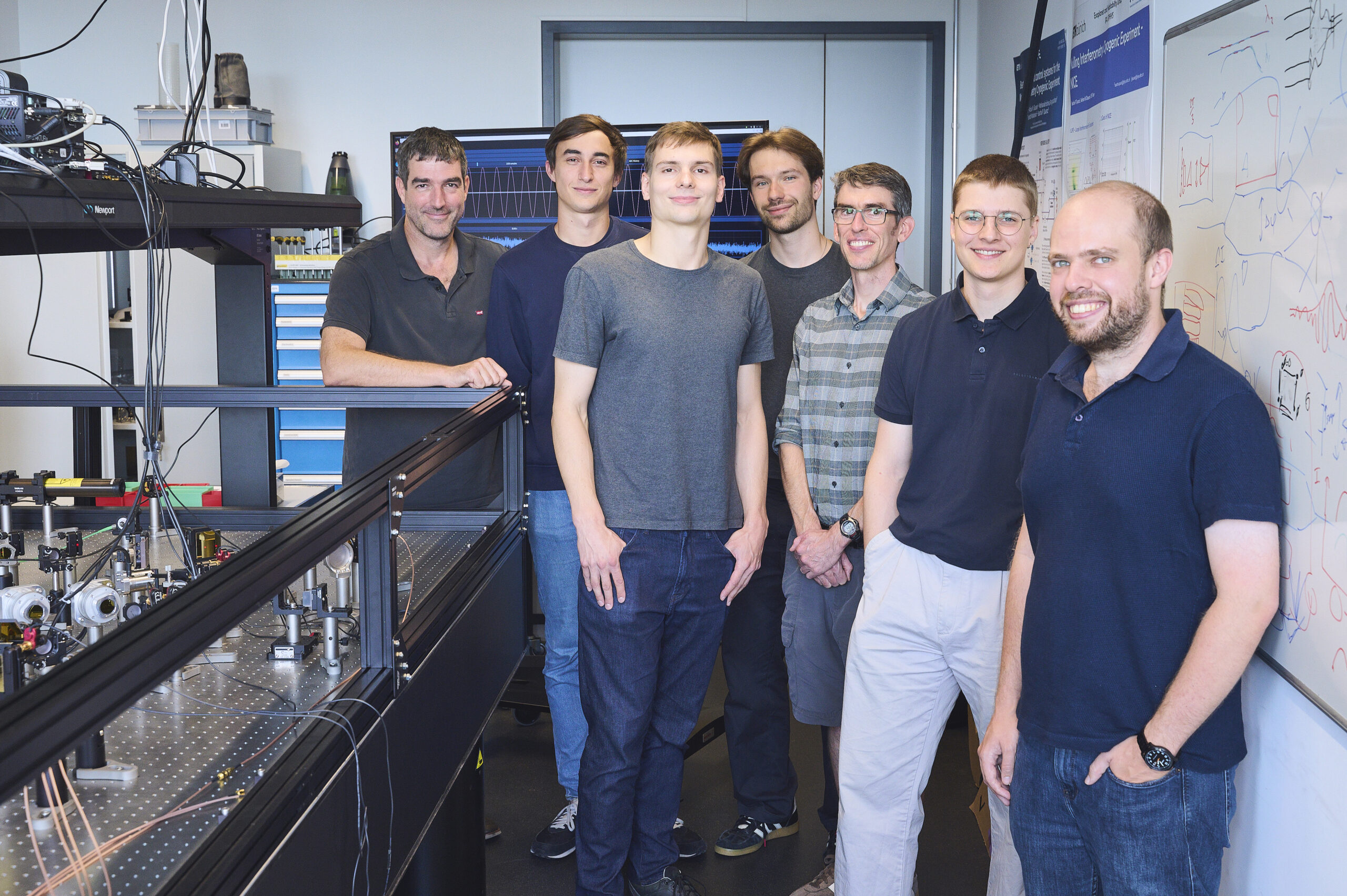
NICE is a collective effort. Alongside Jonah Hansen, the team includes Julio Pino, who engineers the optical design; Thomas Birbacher and Ryan Meierhofer, who developed the metrology system used to compensate for disturbances in the laboratory; Germain Garreau, who focuses on polarization aspects and beam shaping of the experiment; Eckart Spalding working on detectors; David Eglin focusing on alternative concepts for the beam combiner based on photonic technologies; and Adrian Glauser and Maximillian Kirchhoff, who supervise and manage the experiment.
Together, they bring expertise across optics, cryogenics, control systems and instrumentation to the development of the testbed.
How It works
Canceling light, precisely
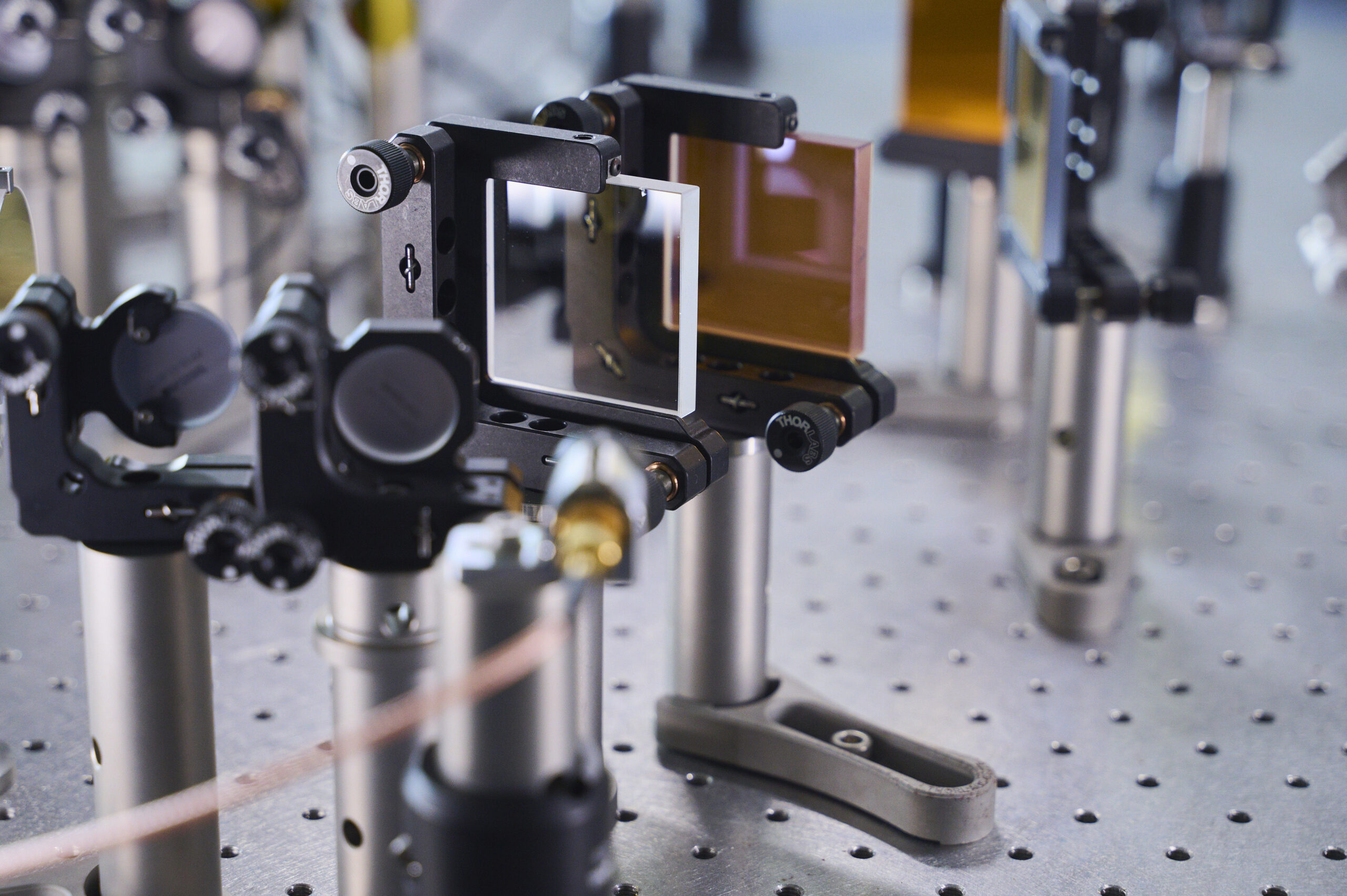
To reproduce the basic measurement principle of LIFE in a laboratory environment, NICE uses a light source to mimic a star. The light is divided into two beams, representing light that would be collected by separate telescopes observing the same star.
Before the beams can be combined, the team must make them as nearly identical as possible. Their intensities have to be balanced to within roughly 0.1%. The difference between their optical path lengths must be controlled on the scale of a nanometre.
For comparison, the diameter a human hair is tens of thousands of nanometres.
Tiny piezoelectric stages help achieve this control. These crystals move by extremely small amounts when a voltage is applied. A rapid control loop continually adjusts the system to compensate for vibrations and other disturbances in the laboratory.
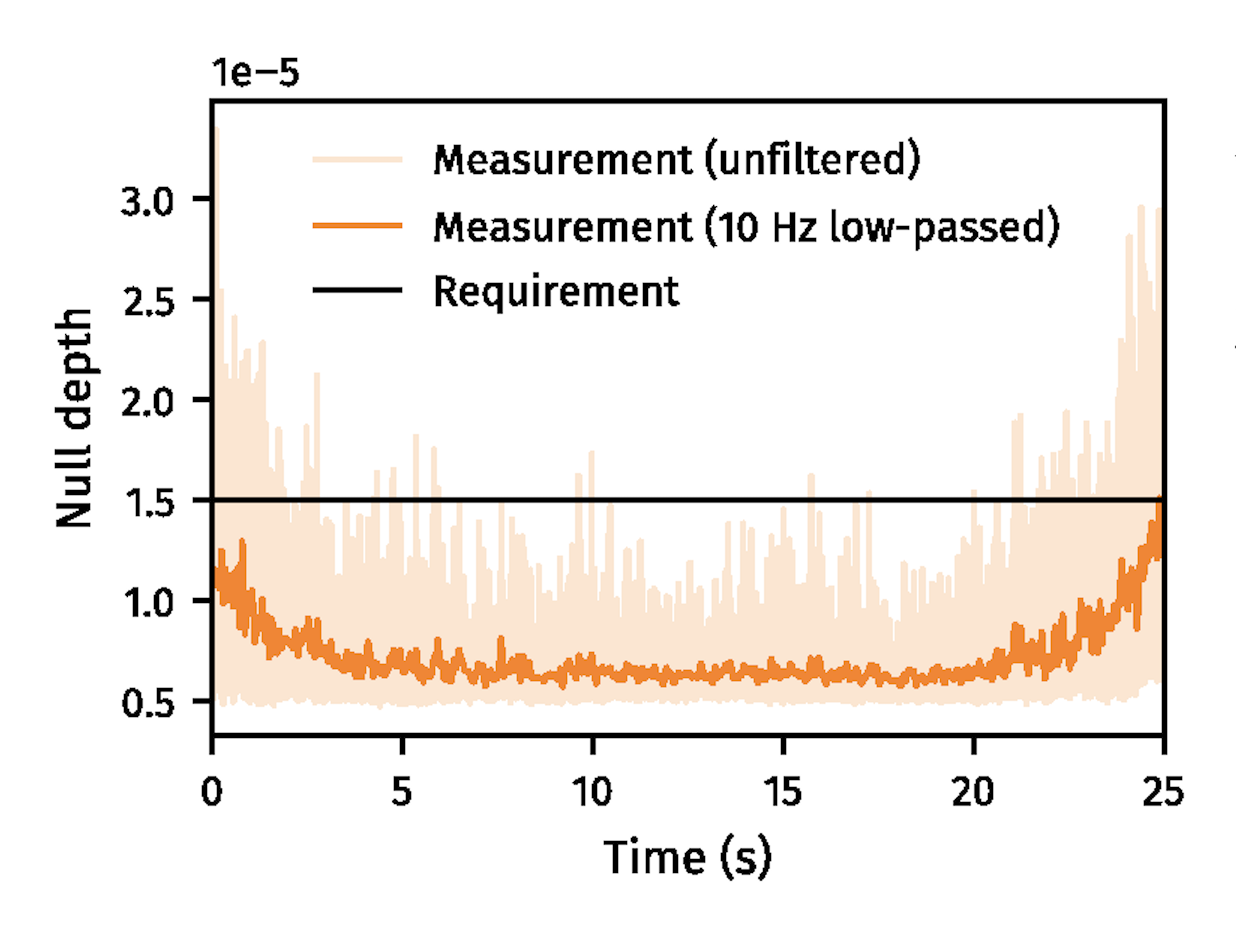
When the two waves arrive in opposite phase, the bright signal is suppressed. The goal is a null depth of 10⁻⁵: reducing the simulated starlight by a factor of 100,000.
THE MILESTONE
A first 10⁻⁵ null
NICE has already reached this level at a single laser wavelength under ambient laboratory conditions, maintaining strong suppression for around half a minute. It was an important first milestone — but not yet the full demonstration LIFE needs.
Why simulations are not enough
Models and simulations are essential to designing a mission. But they can only include effects scientists and engineers have anticipated.
“One of the key elements of a complex mission like this is the unknown unknowns,” Jonah explains. “We can only simulate the effects we know about and put into the simulation.”
A physical testbed exposes the system to real materials, imperfect components, thermal changes, scattered light, vibrations and interactions that may appear insignificant in other experiments. At the precision NICE requires, those subtle effects can become the limiting factor.
The development of high-performance mid-infrared optical fibres is one example. Technologies for visible and near-infrared light are relatively mature. In the mid-infrared, the available materials and components are less developed, more difficult to manufacture and sometimes challenging to handle. The team therefore has fewer ready-made options — and must often find new ways around their limitations.
That is not a detour from the purpose of NICE. It is the purpose.
Every unexpected effect discovered on the optical bench is a problem that can be understood before LIFE is built for space.
The coolest part of the challenge
LIFE targets the mid-infrared because temperate planets emit thermal radiation in this part of the spectrum and because it contains spectral features from atmospheric molecules of scientific interest. But there is a complication: objects at room temperature glow brightly in the infrared too.
The researchers themselves, the laboratory walls and even the instrument’s own optics produce thermal radiation. Against the extraordinarily faint signal expected from a distant planet, this background would be overwhelming.
NICE must therefore eventually cool its optical system to around 15 Kelvin, approximately −258 °C. At that temperature, the instrument emits far less thermal radiation. Baffles will also help prevent stray light outside the cryostat from entering the measurement.
Cooling a precision optical system introduces new problems. Materials contract as their temperature drops. Components that are perfectly aligned at room temperature can shift during cooldown, while fibres, actuators and mechanisms must continue to function in an extremely cold environment.
To investigate this, the team has commissioned a smaller test cryostat nicknamed Ice Cube. It allows them to study how mounting techniques and individual components behave on the journey from room temperature down towards 15 Kelvin.
15K
−258 °C
TARGET TEMPERATURE
High precision, low-tech ingenuity
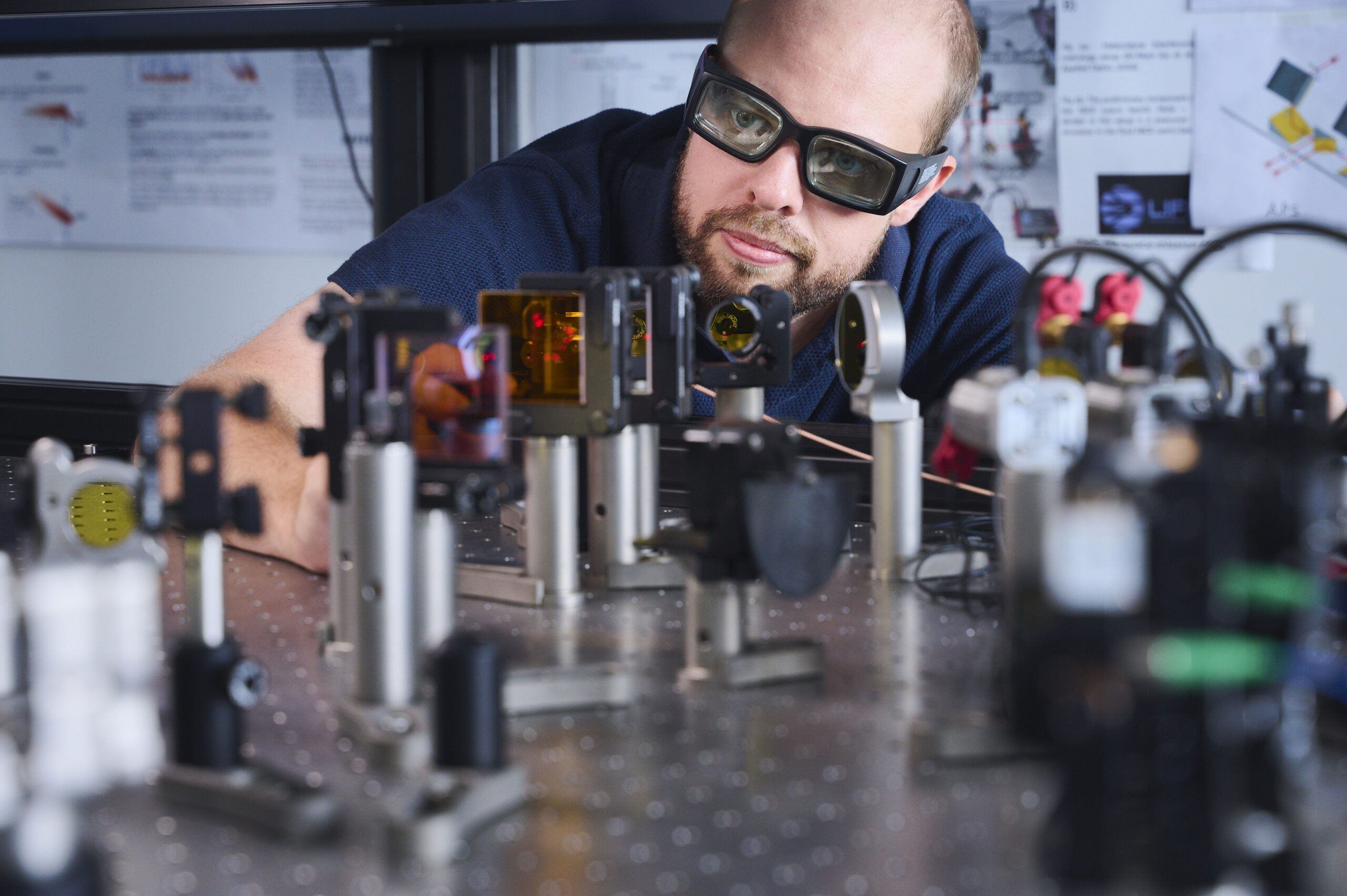
Walk into the NICE laboratory today and you will find advanced metrology, specialised optics, high-precision control systems and a custom-built enclosure around the experiment. But the setup has not always looked this polished. It began with IKEA curtains, notepad paper used for fine height adjustments, cardboard serving as a temporary beam blocker and an assortment of 3D-printed mounts. This combination of advanced technology and practical ingenuity is less contradictory than it sounds.
Laboratory experiments evolve. Researchers need to test, adjust and replace ideas quickly. Sometimes the best temporary solution is not the most sophisticated one, but the one that works reliably and allows the next measurement to happen. The environment itself adds to the challenge. The laboratory sits on an upper floor of one of the tallest buildings on the ETH campus — not an obvious place to isolate an experiment from movement and vibration. A metrology system developed by Thomas Birbacher helps correct many of these disturbances. Even so, aligning the complete setup to the precision required for nulling can take a full week.
The team is now automating more of that alignment and acquisition process. The immediate payoff could sound modest: finding the correct position of several stages and actuators with the click of a button. In practice, it would make the experiment more repeatable and free the researchers to focus on the next layer of the problem.
What comes next
What success will look like
The long-term NICE demonstration goes well beyond cancelling a laser at one wavelength. Success means producing a deep null across many mid-infrared wavelengths simultaneously, using an unpolarised broadband source that better represents astrophysical light.
It must also work at the extremely low optical powers relevant to planet observations, under cryogenic conditions around 15 kelvin, and remain stable throughout observations lasting hours.
With a broadband source, the detector may need to measure signals on the order of femtowatts. One femtowatt is watt.
Reaching all these conditions together would demonstrate one of the most demanding parts of LIFE’s measurement concept and provide crucial evidence that the planned observation is technically feasible.
10⁻⁵
BROADBAND · UNPOLARISED · FEMTOWATT LEVELS · 15 KELVIN · STABLE FOR HOURS
Explore more of LIFE’s technology